enjoy the ride
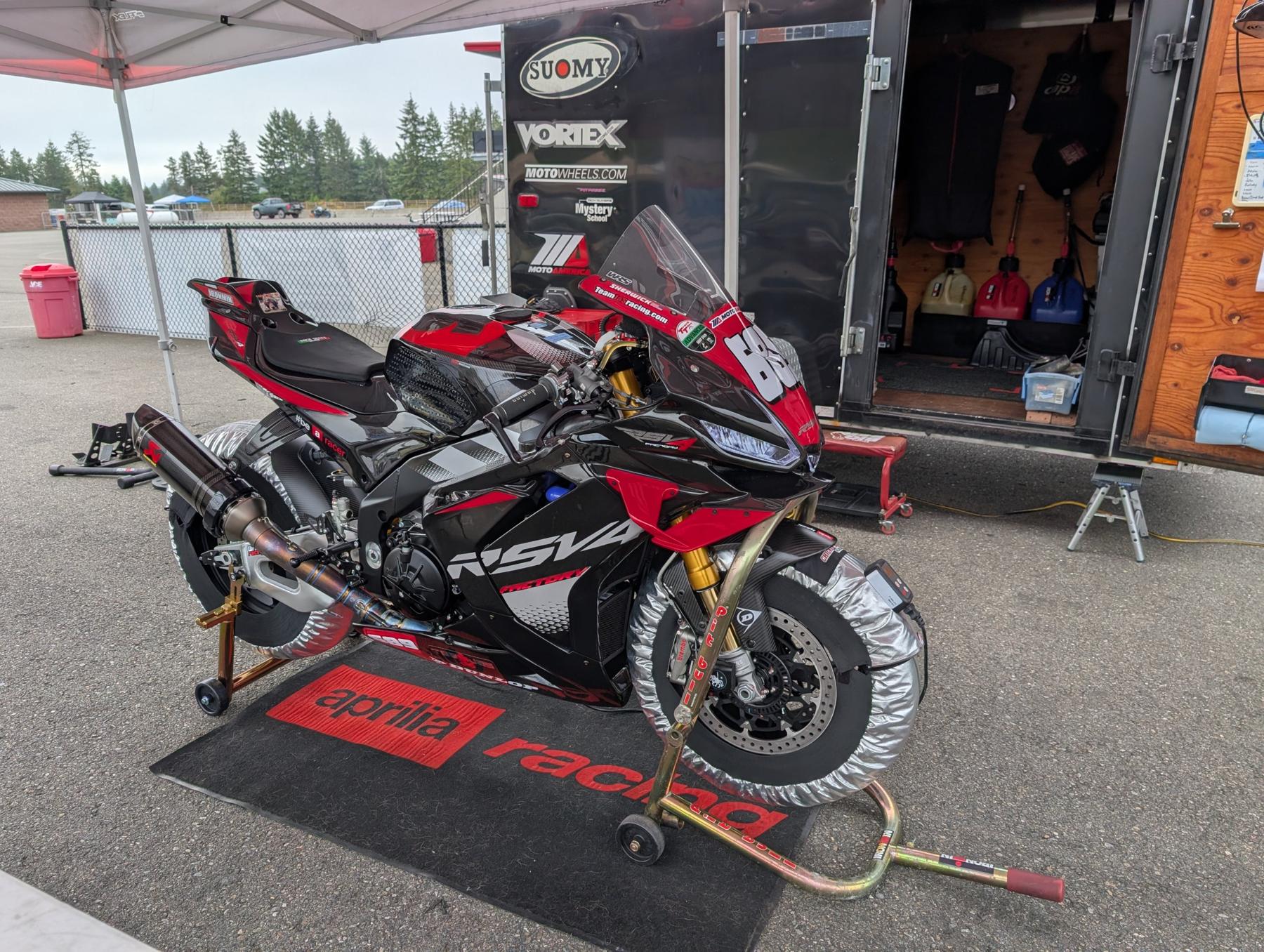
2026 Aprilia RSV4 Factory 1100 built by Warhorse HSBK Racing, Dunmore, Pennsylvania
A new-for-2026 RSV4 Factory that went to Warhorse HSBK as a stock bike and came back as a race machine: Akrapovič titanium and carbon exhaust, Brembo T-Drive rotors, Dunlop slicks, race bodywork, a re-flashed ECU, and a data system that logs almost everything the bike does.
Watch the build
The video Warhorse HSBK posted of the finished bike.
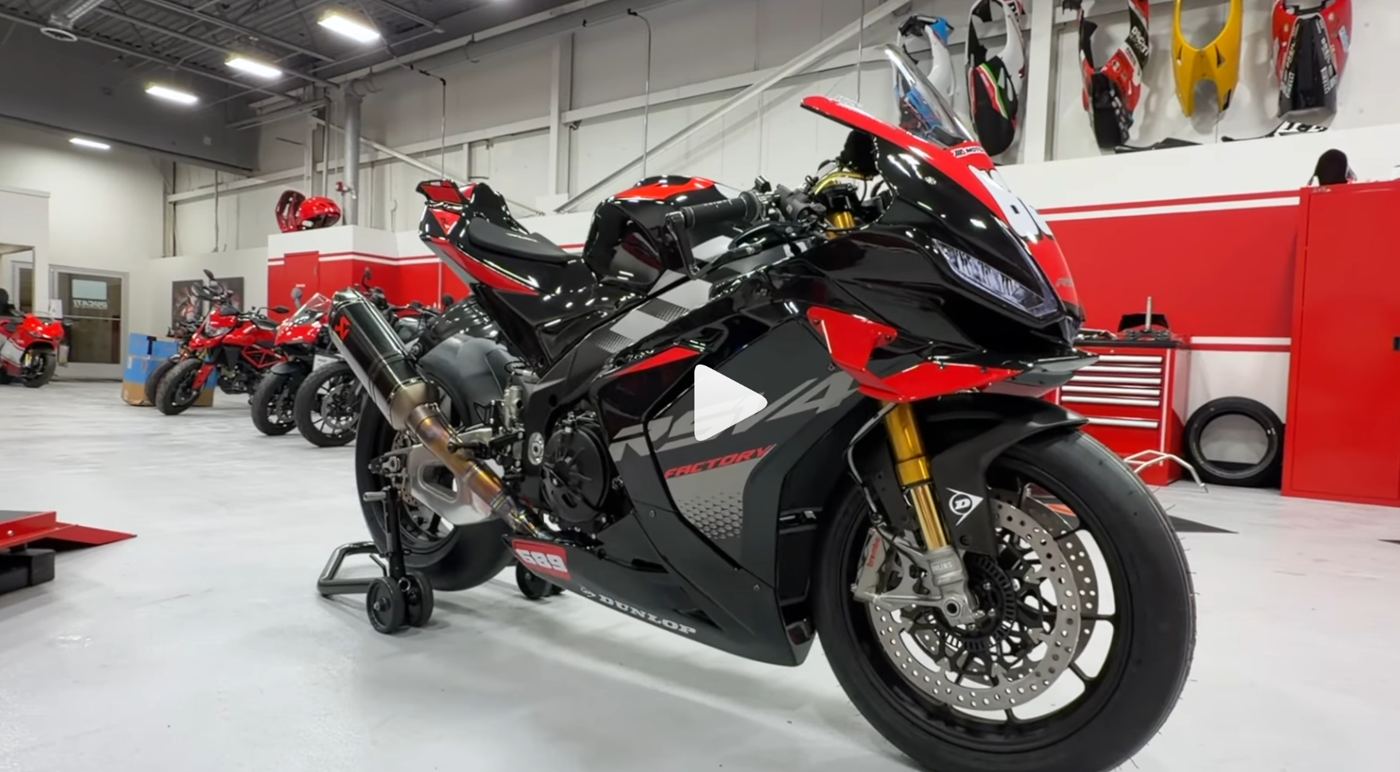
In the comments under their posts, the shop said they can program the Öhlins semi-active suspension with their own values, and that the factory-style race fairings on the bike are prototypes they are building themselves.
The Öhlins Smart EC suspension stayed on the bike rather than being swapped for a manual set, as Bobby Shek said Loris Baz was within a sec of his lap time on the Öhlins Smart EC system!
The thumbnail opens the video on Instagram. To watch here instead, use the button on the thumbnail (Instagram's player brings its own caption panel). Open it on Instagram.
What makes this build different
Details pulled from the build sheets, the parts list and the setup notes.
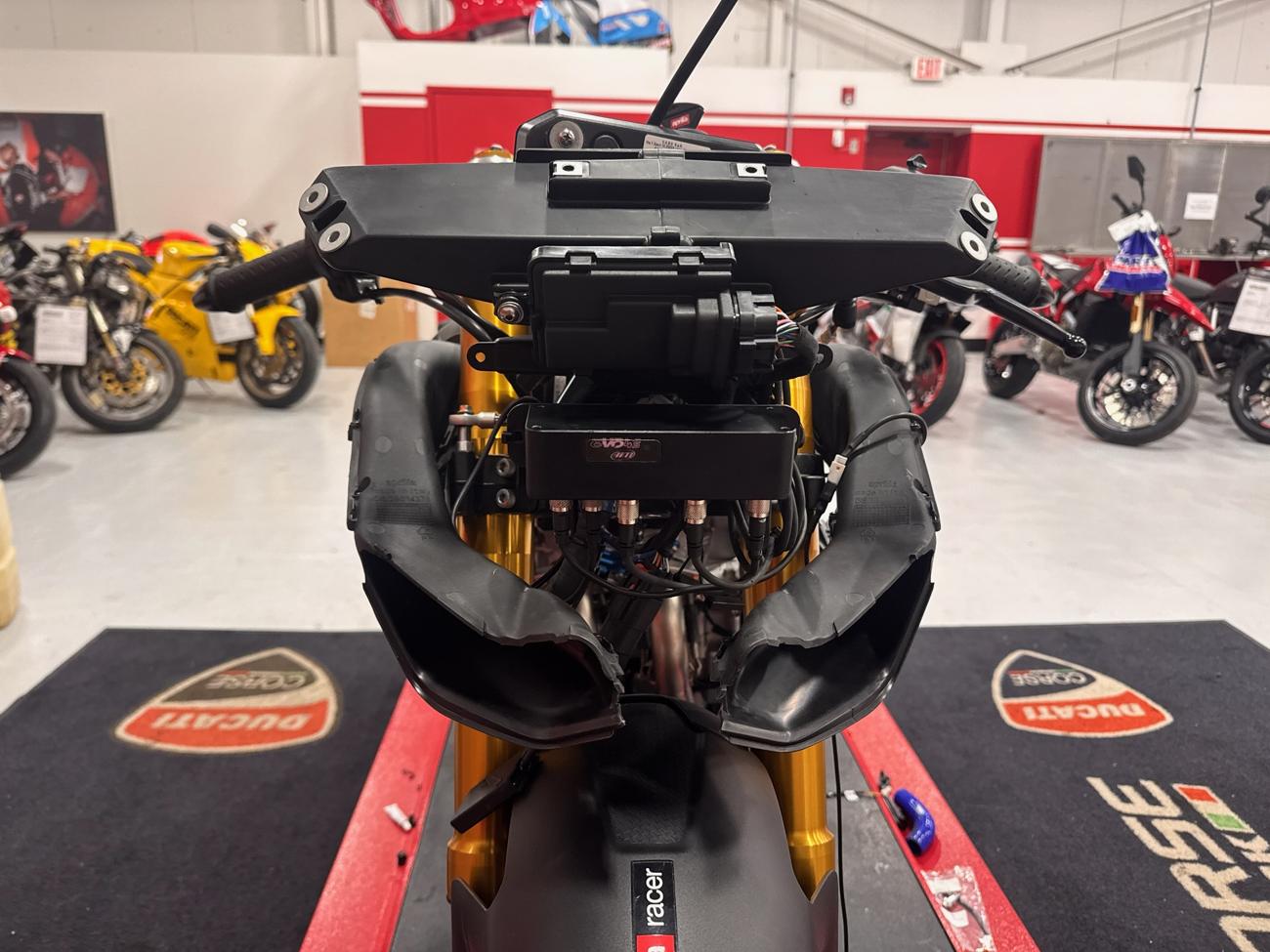
Three data systems on one bike
The Factory already carries Aprilia's MIA unit and GPS module for lap timing and Corner-by-Corner. Warhorse HSBK added an AiM EVO4S with a GPS 08 on top of that, plus two linear potentiometers for front and rear suspension travel and a 100 bar brake pressure sensor. The 2016 RF on this page ran a similar EVO4 sensor package, so the data compares across generations.
The EVO4S sits behind the nose, with its cables running to the sensors at the forks and shock.
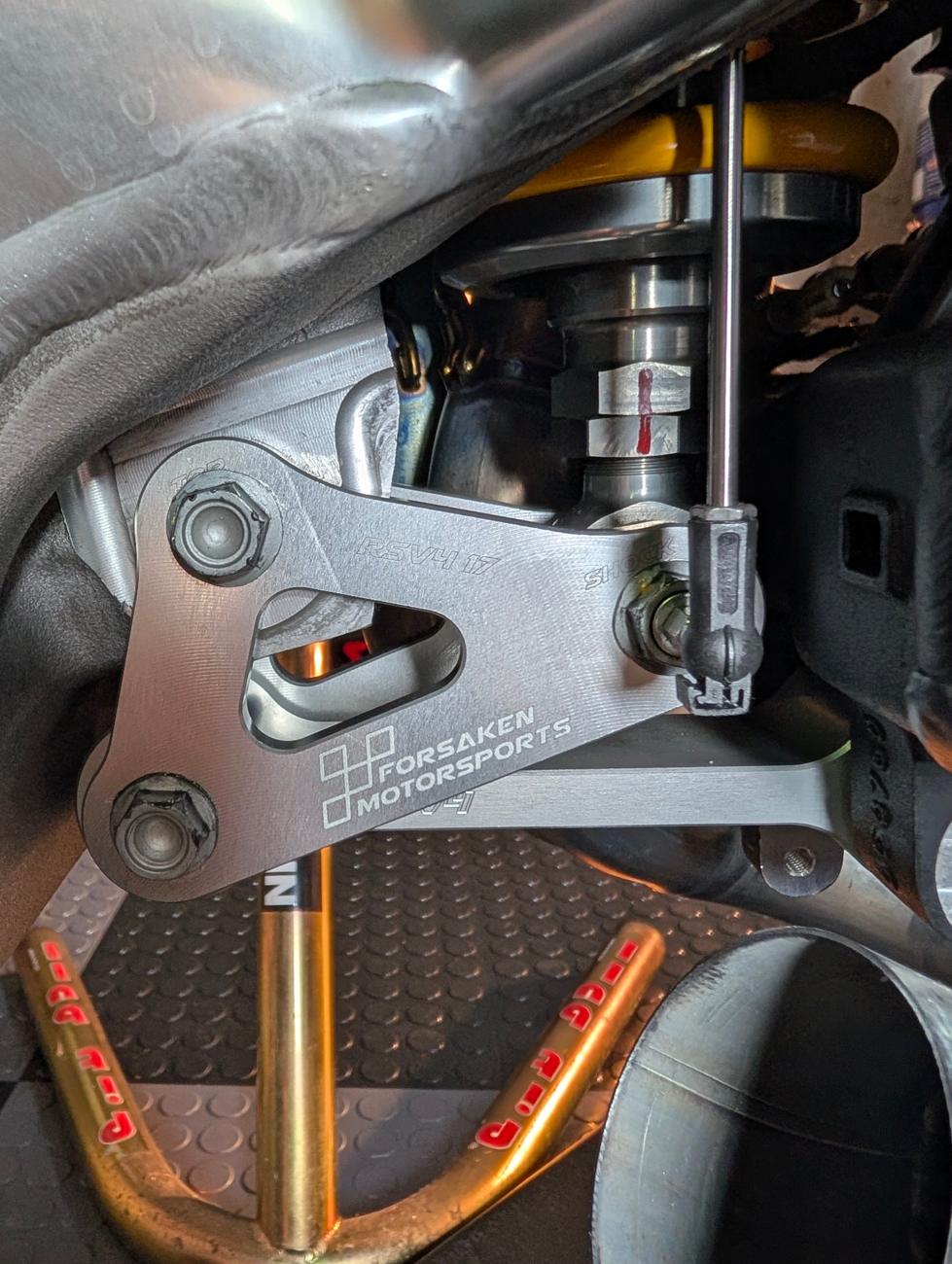
A linear race linkage replaces the stock progressive one
A race linkage replaces the stock progressive one. The shock potentiometer rides alongside it. The suspension sensors are zeroed with the bike on its stands.
The other photo shows the shock-side mount, with a bracket carrying the rod.
Talking to the 2026 CAN bus without upsetting the ECU
The 2026 bike uses a newer Marelli 11MP ECU and a more sensitive gateway than the 2021 to 2024 bikes. Four rules from the setup notes keep the logger quiet and the dash happy:
- Power the EVO4S from the switched ignition pin, never the permanent battery pin. On the Factory's small lithium battery, an always-on logger can flatten it in about 48 hours.
- Wire CAN High and CAN Low to the correct pins. A wrong tap or a voltage drop can throw U1701 or U1702 (communication lost with ECU) on the dash.
- Turn Silent Mode on in Race Studio 3. Otherwise the logger acknowledges packets on the bus, which the ECU can read as a fault.
- Leave the 120 ohm termination resistor off, because the bike's bus is already terminated.
Setup used Race Studio 3 version 3.82.14, EVO4S firmware 01.32.44, and GPS 08 firmware 35.65.00.
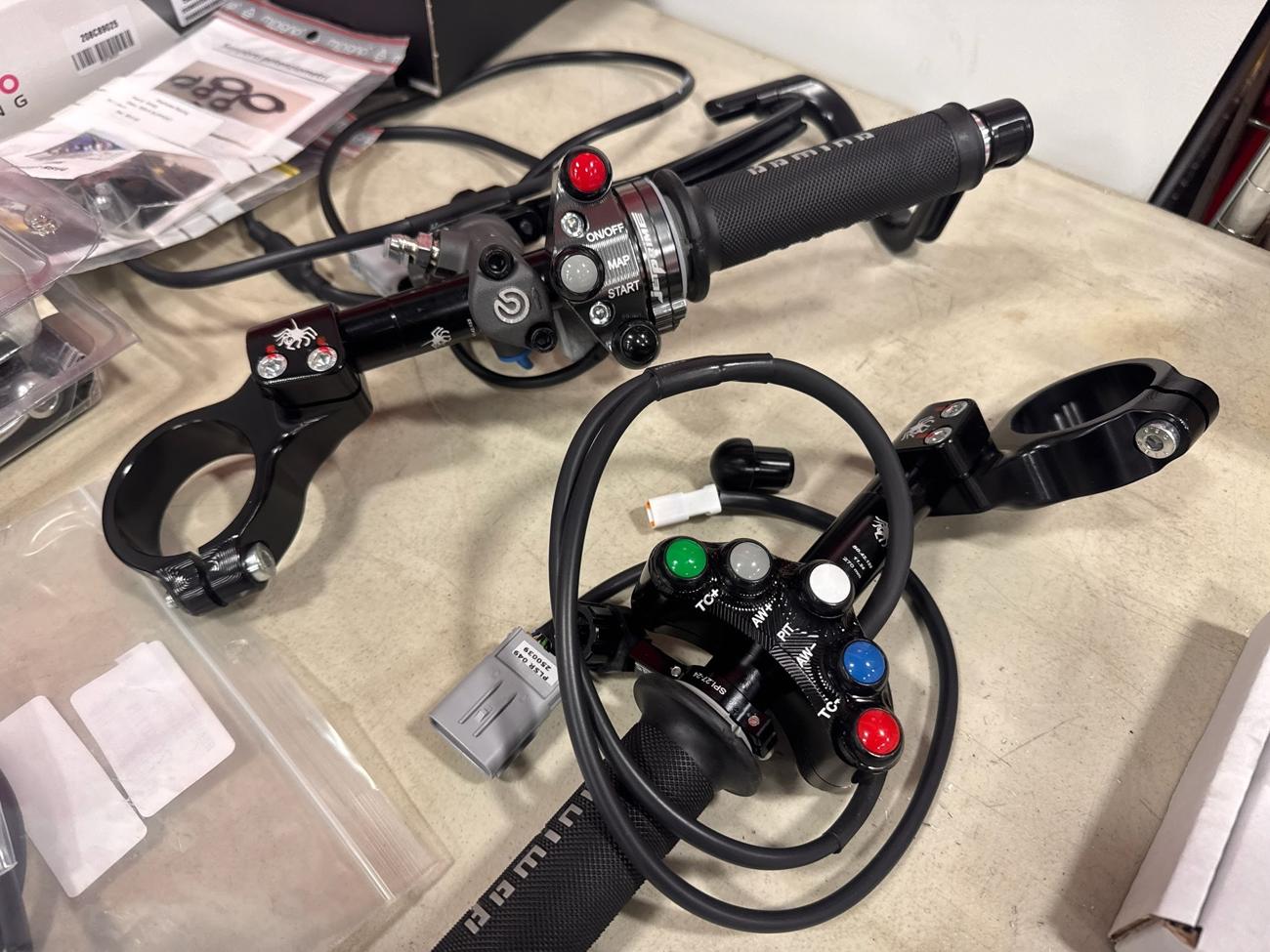
Everything adjustable is under a thumb
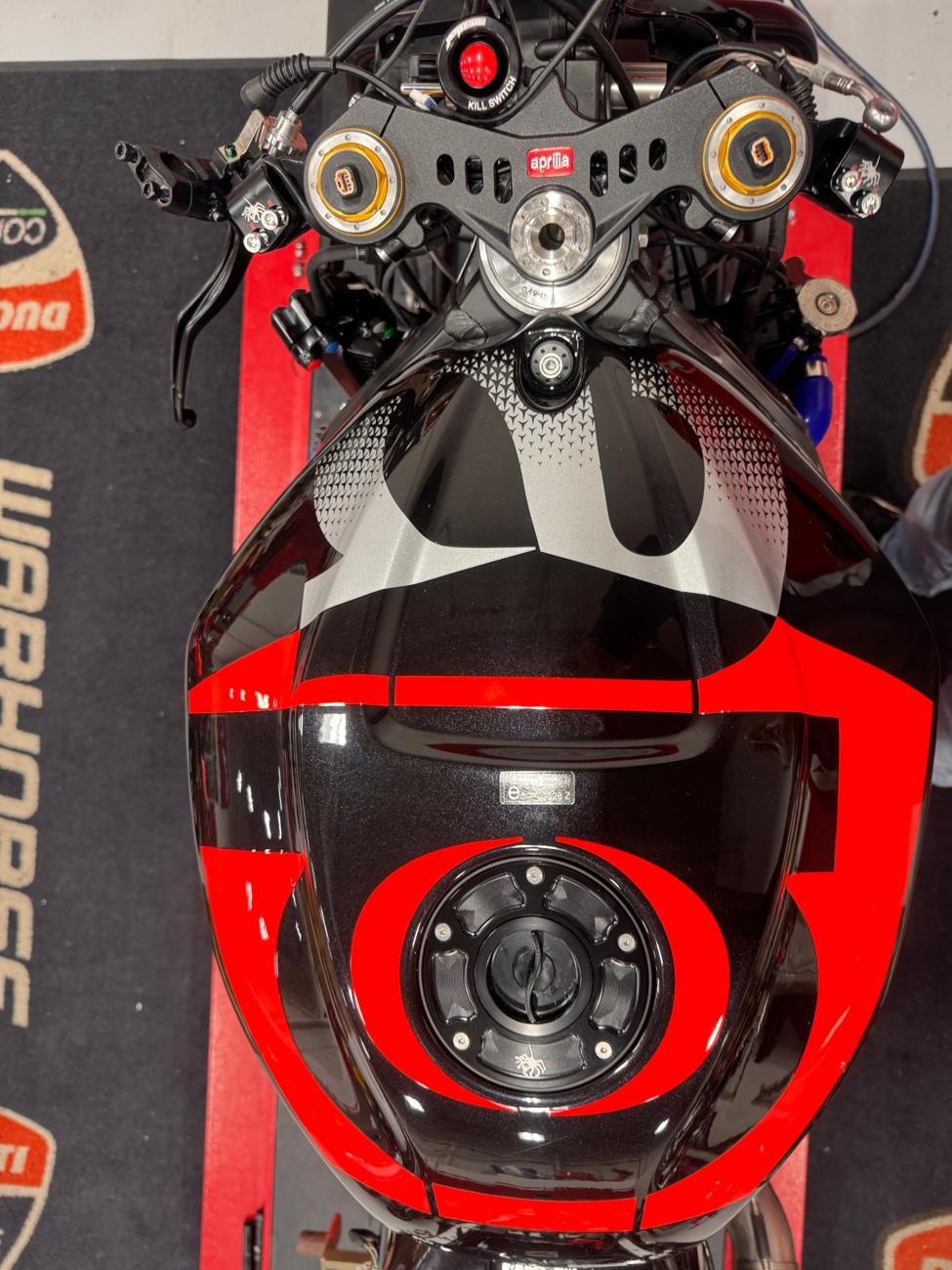
The left switch cluster carries traction control up and down, wheelie control up and down, and the pit-limiter button. The right cluster has engine on/off, map and start. A race kill switch sits on the top triple clamp, and a quick-turn throttle kit shortens the twist to the stop.
Shift light is set for 13,000 rpm and the pit limiter has been lowered to 25 mph for track days.
Per-sector rider aids with Corner-by-Corner
Four rider-aid profiles (CM1 to CM4) are programmed on the dash. The Aprilia MIA app maps them onto the sectors of a track, and once the GPS recognizes the circuit, the bike switches traction control, wheelie control, engine braking and the ABS setting as it moves through each sector, with no switching by the rider. It works only in Race mode.
The settings screen for one sector shows the four values you can change per section: AWC, ATC, AEB and ADC. The table lists the values programmed for all 17 sections.


Tap a screenshot to enlarge.
Slide Control still works with the ABS deleted
Warhorse HSBK fitted an ABS delete plug, but the wheel-speed sensors stay live. Aprilia's Slide Control does not use the brakes at all. It fuses data from the IMU, the wheel-speed sensors and torque demand, and cuts power through the ride-by-wire throttle first. If a slide is sudden, it retards the spark or cuts fuel to individual cylinders. Because the ECU still sees wheel speeds, the control loop stays intact.
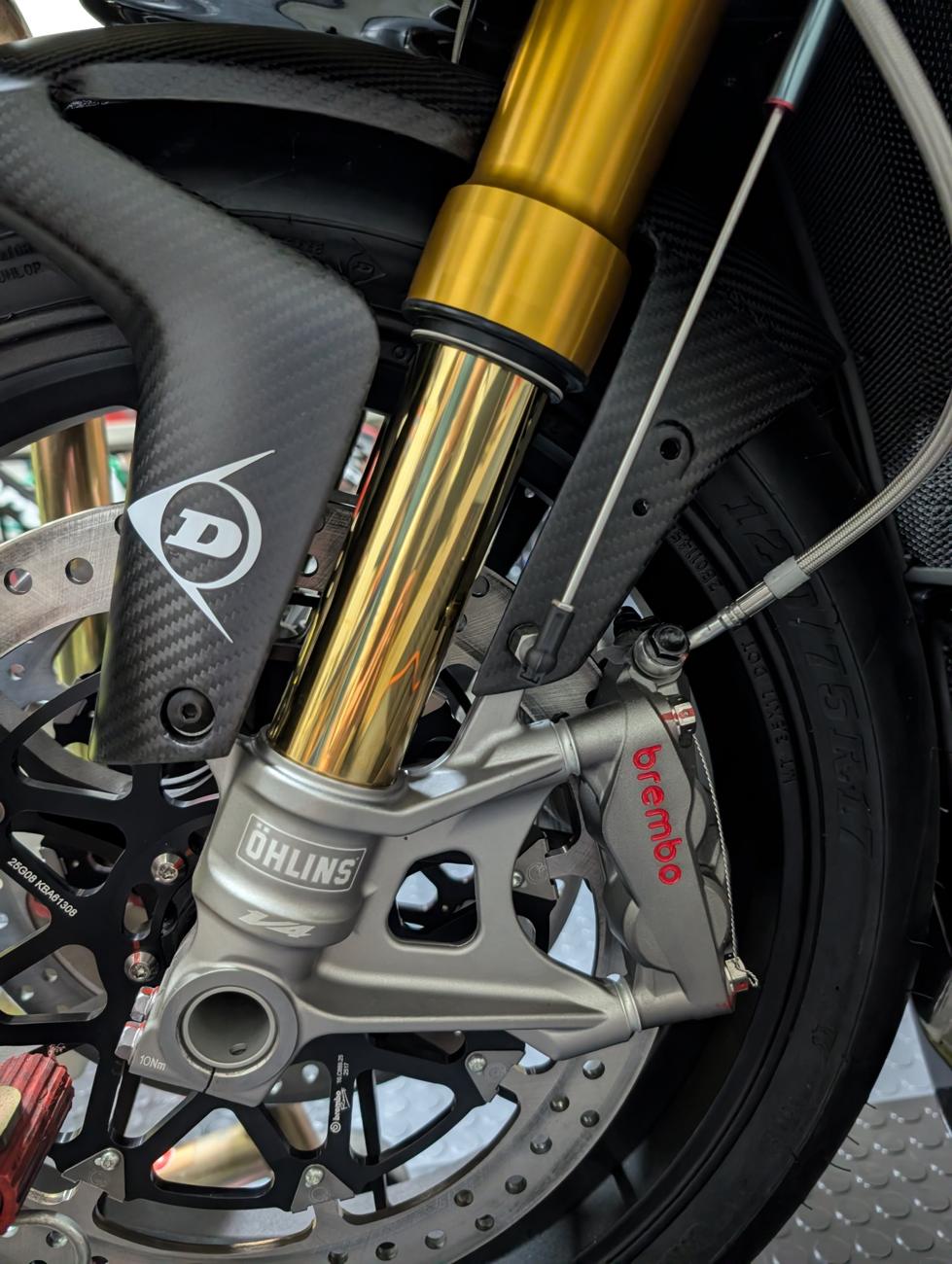
Smart suspension that thinks in clicks
The Factory's Öhlins Smart EC 2.0 uses small stepper motors to turn the needle valves, the same valves found in the manual TTX36 shock and NIX30 fork. In manual mode you can dial in a specific number of clicks and it holds them like a conventional setup. Each full sweep takes about 0.2 seconds, which is why Öhlins calls it semi-active rather than fully active.
- Travel: 125 mm front, 115 mm rear
- Preload stays manual. Only compression and rebound are electronic.
Power and gearing
Rear-wheel power, Dynojet
The 2026 bike made 205.9 and 206.7 hp on two pulls, about 94 percent of Aprilia's crank claim.
Top speed by gear, 14,000 rpm
One tooth up on the rear (42T instead of the stock 41T) costs only 4 to 5 mph of theoretical top speed versus stock (188 mph). A 44T would drop it to about 175 mph. The 42T also keeps the stock 110-link chain length workable, with the axle moved forward in the adjusters.
Build highlights
Engine: 1,099 cc 65° V4 with 52 mm throttle bodies, claimed 220 hp. Measured at the rear wheel on a Dynojet at North American Warhorse: 206.7 hp at 154.9 mph.
ECU: Marelli 11MP, with a Warhorse HSBK map update. Secondary air system deleted.
Exhaust: Akrapovič EVO titanium and carbon-fiber full system.
Brakes: Brembo Hypure calipers, 330 mm T-Drive rotors held with 17 titanium bolts, Z04 racing pads, 19x18 master cylinder with folding lever, remote adjuster.
Suspension: Öhlins Smart EC 2.0 semi-active fork and shock, Forsaken Motorsports RSV4 linkage, 125 mm front and 115 mm rear travel.
Final drive: 16-tooth front and 42-tooth aluminum rear sprocket, DID 520ERV7 chain, titanium locking nuts.
Data: AiM EVO4S with GPS 08, two linear potentiometers and a 100 bar brake pressure sensor, alongside Aprilia MIA and GPS with Corner-by-Corner.
Rider aids: aPRC with a 6-axis IMU and Slide Control, ABS delete plug, quick-turn throttle, race switches on both bars and a race kill switch.
Bodywork: Prototype RSV4 race bodywork set in custom two-color paint, with die-cut artwork, a carbon-fiber front fender and rear hugger, and Dzus quick-release fasteners.
Cockpit: Adjustable clip-ons, reverse-shift rearsets, a tall race windscreen, a rain light and Dunlop slicks.
Cooling: Custom black radiator with a 2.0 bar cap and blue Samco silicone hoses.
Gallery
Tap any photo to enlarge.