Training the rider, on track and in the head.
Two parts. Riding craft holds the lessons I practice on track, from Rich Oliver’s Mystery School and Ken Hill Coaching. Race-weekend mindset is the routine I follow from race week to the checkered flag, from Craig Muirhead’s Camino Coaching course. Both are a record of what I practice, not a step-by-step guide.
What I have learned from champions and the best in the sport.
Nobody gets faster by reading a book alone. These notes, written in my own words, capture lessons from Hall of Famer Rich Oliver at his Mystery School and from Ken Hill, who has coached some of the best riders in AMA MotoAmerica. They are not a step-by-step guide, but a record of what I practice and what the process has taught me about myself. I share them in the hope that they encourage you to learn through practice and discover what works for you.
The big ideas
- Work backwards from the exit. Decide where I want to be on full throttle, then reverse-engineer the turn-in, the brake release and the brake point.
- The slowest point is the pivot. It ends deceleration and starts acceleration, at the greatest lean angle, so I want it short and I want no neutral throttle there.
- Radius drives everything. A long corner gives time for earlier, gentler inputs. A short corner needs later, quicker, more decisive ones.
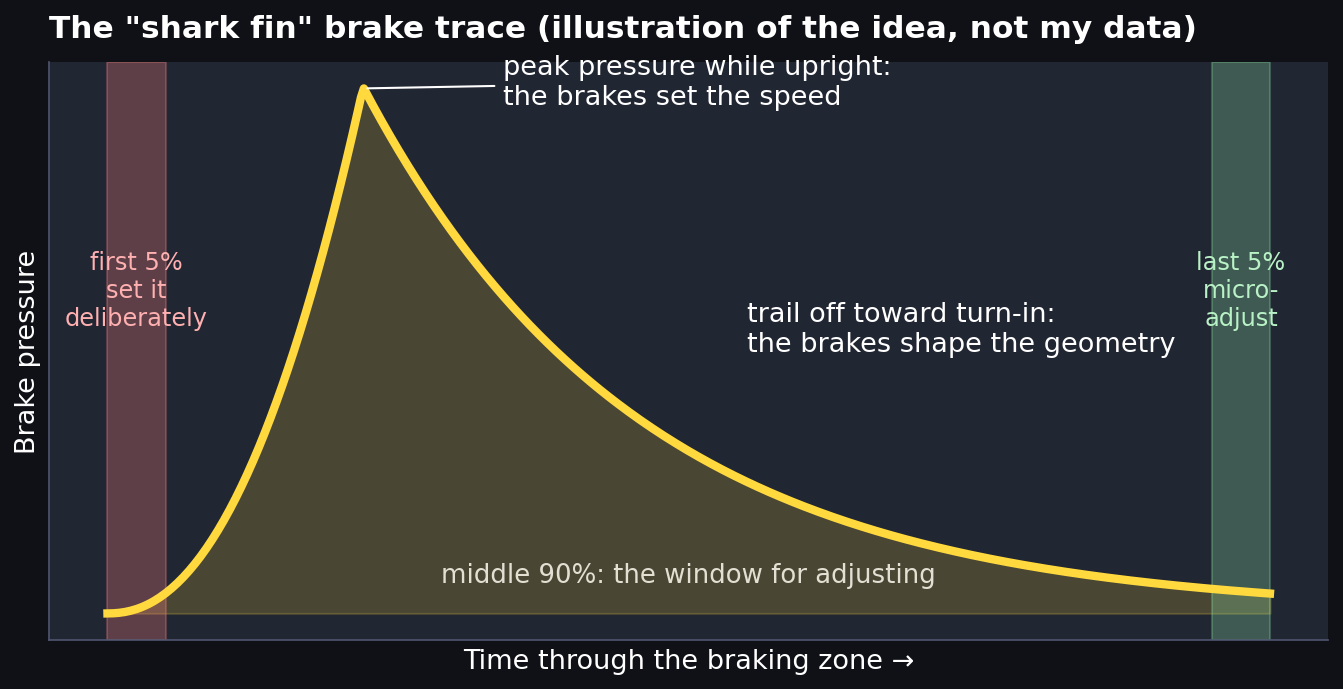
- 5 / 90 / 5. The first and last five percent of any control or body movement are slow and deliberate. The middle ninety is where adjustments live.
- Don’t over-slow entry. Pick the point where I mean to release the brake, like a stop line, and ride to it.
- Keep the eyes moving. Scan the edge of the track, the entry apex and the exit apex, and use reference points off the track.
The six fundamentals, in priority order
| # | Fundamental | What matters to me |
|---|---|---|
| 1 | Eyes and focus | Constantly scan and triangulate. Don’t fade into a corner by staring only at the apex. |
| 2 | Motor controls | Brakes, throttle and clutch, applied smoothly. |
| 3 | Bike placement | Get to the point where I can accelerate to full throttle. Reverse-engineer from the exit. |
| 4 | Brakes | Upright, the brakes set speed. At turn-in, they shape geometry. |
| 5 | Body position | Tell the bike what to do, calmly and early. |
| 6 | Turn-in rate and point | The faster I go, the earlier I turn in and brake. Slower, later. |
Entry corners, exit corners, balanced corners
Entry corner
Deceleration dominates. Brake to or past the apex and keep neutral throttle to a minimum. The slowest point comes after the apex.
Exit corner
Acceleration dominates. Be on the throttle at or before the apex. The slowest point comes before the apex.
To prioritize where to work, find the three longest, fastest straights and focus on the corners that lead onto them.
Brakes, throttle and body
Brakes
- Apply deliberately, not abruptly.
- Don’t overdo the first moments: too much weight transfer.
- Do downshifts early in the braking zone and release the clutch cleanly.
- Fingertips on the lever.
Clutch & throttle
- Clutch: fast in, slow out.
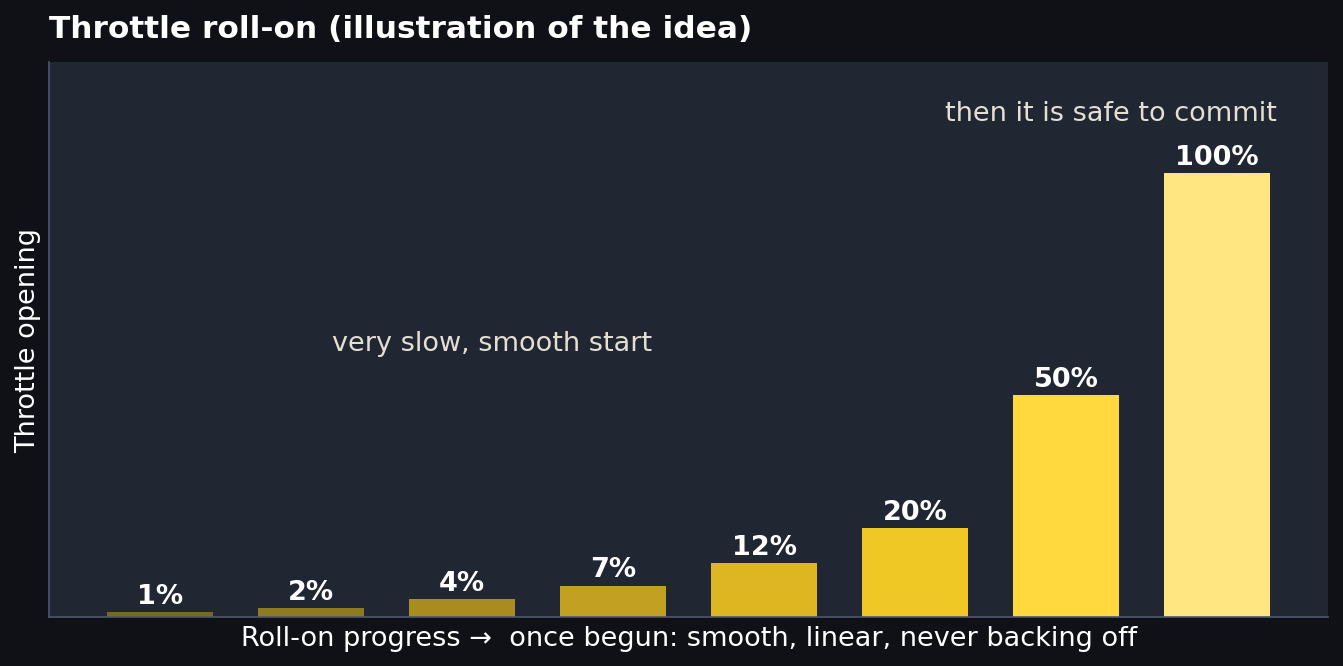
- Throttle: a very slow start, then linear and never backing off.
- Keep neutral throttle to a minimum.
Body position, in three steps
- Sit up on the brakes. Chest toward the tank, palms on the bars for feel, balls of the feet on the pegs, and get off the seat early.
- Load the inside peg. Keep the inside arm light and steer mostly with the outside arm. Lead with the head.
- Add throttle, take away lean. Tight core, relaxed hands, push the bike away and weight the outside peg.
Learning a new track
The checklist I follow on a first weekend somewhere unfamiliar.
- Mark up a track map. Label the three longest or fastest straights A, B and C, then mark exits (off the brakes before the apex) and entries (off the brakes at or past the apex).
- Start with exits. Work on bike placement, the first throttle and picking the bike up. Note reference points such as corner-worker stations or trees.
- Build entries gradually, raising braking and entry speeds until the exits start to suffer.
- Aim for precision first, in the first laps.
- Find the slowest point of each corner and review the report cards below.
- Check consistency: apexes, use of the track on exit, entries parallel to the outside.
- Compare segment times. Work on the biggest gaps first. If the gaps are even everywhere, go back to the fundamentals.
Report cards after each session
- How much neutral throttle?
- When do I have direction?
- When am I at full throttle?
- How much of the track did I use on exit?
The rear brake, wet weather and feel
Using the rear brake
Right before the front brake, it settles the rear and reduces pitch. Worth using for downhill braking (The Ridge Turn 7, Sonoma Turn 4), tightening a radius mid-corner (Chuckwalla Turns 4–5, Sonoma Turn 6), keeping the front down at exits, and as a gentle form of traction control. Develop feel first.
Riding in the rain
Less grip means less application. I study the weather and the surface, keep the hands loose to feel grip, favor lines that maximize straights, and expect the slowest point to come earlier and slower. Brake earlier and longer, apply the throttle smoothly, and consider softer suspension and lower tire pressure or rain tires.
Developing feel
Feel is confidence. React in real time, keep the controls consistent so anything new stands out, unweight the hands, and move weight from the core to the feet (inside peg at the apex, outside peg on exit). Off-bike training such as dirt track, go-karts and cars all feed it.
Lessons from Rich Oliver’s dirt-track camp
At the track
- Make exits, full throttle and straights consistent.
- Work on braking, whether point-and-shoot or trailing.
- Fix slow corners and problem areas.
Set a goal that my mind believes the bike and I can do. Be patient with the throttle and swivel the hips into the corner.
Words worth knowing
- Brake slide: the rear wheel is slower than the ground speed.
- Power slide: the rear wheel is faster than the ground speed.
- Passing: block passes are the easiest and safest; long corner passes are the hardest and most dangerous.
The head game is a body game.
Racing is stressful by design, and I have learned that calm, confidence and aggression can be tuned. This page summarizes the routine I follow, based on Craig Muirhead’s Camino Coaching course. It is a performance-coaching framework, not medical advice, and some of the course’s figures are not independently verified.
The core idea
Stress is not the enemy. The aim is to keep each stress chemical in its band: not too flat, not too wired. Practised tools, a routine and good sleep make that repeatable rather than lucky.
The chemistry ladder
Each rung has a small tool. For example: name the feeling, then one slow breath in through the nose (four counts in, six out). Replace a vague outcome with one specific goal for the session. Build a short list of factual wins to read before a weekend.
The weekend, layer by layer
| When | What I do | Why |
|---|---|---|
| Race week, daily | Log sleep and heart-rate variability on waking. Mental rehearsal of the goal. | Know the base everything else sits on. |
| Before going out | Box breathing. A touch ritual with a teammate. “Possibilities, not expectations.” | Settle the body and replace outcome-thinking. |
| Free Practice 1 | Five laps each focusing on what I can see, then feel, then hear. | Gather information; train attention one sense at a time. |
| Every session | One clear goal. A few personal trigger words to keep attention in the present. | A specific target keeps me engaged and calm. |
| On track | Ask “What’s my job?”, answer it and ask again, all the way to the flag. | Stay in the present lap. |
| Right after | Say “That’s done.” One long exhale and a thank-you. One factual win, one cost, one next step. | Close the loop so nothing carries into the next session. |
| Evening | Wind-down routine and sleep. | Most of what I build, I build asleep. |
Sleep and recovery
Sleep is the base under every other tool. These are the habits I aim for the night before and during a race weekend.
- Set a bedtime and a wake time.
- Finish exercise two to three hours before bed.
- Skip caffeine late in the day and alcohol before bed.
- No large meals right before sleep.
- Dark, cool room.
- No screens for an hour before bed.
- Get natural daylight every day.
- If I wake at night, don’t check the phone for the time.
Travelling east is usually harder than west. Adjust bedtime before the trip, hydrate with water, and get daylight on arrival. Talk to a pharmacist or doctor before using any supplement.
If this, then that
| I notice… | I reach for… |
|---|---|
| Jaw tight, breath held, grip clamped | Name it, then one reset breath (in four, out six), then back to the job. |
| A bad lap and the inner critic is loud | Two long exhales, “I belong here,” name one thing I did well, then next step. |
| Judging or comparing | “That’s interesting.” This lap is information, not a verdict. |
| Feel fast, but the stopwatch disagrees | Go back to facts and reference points. |
| Flat, no urgency | Add one trigger: a sharper target or a visible small win. |
| Wired and over-driving | Drop the tempo: four in, eight out. Shrink the goal to one corner. |
| Session just ended | Ten seconds: “That’s done.” One win, one cost, one next step. |
Goals for 2027
Next season centers on The Ridge Motorsports Park, my home track, on the chicane layout (2.47 miles, 16 turns). I compared my best August laps there on two bikes, lap by lap, against my coaching notes. Being honest about what is holding me back is part of getting better.
My goals
- Test the Forsaken race link and diagnose the headshake. The headshake starts on the front straight at upshifts, with the fork nearly fully extended and the front lightly loaded. Before blaming the shock, check the steering damper setting first and hold front preload where it is. At The Ridge, log the front straight and compare how often an upshift is followed by a shake, and how far the rear sits under drive, with and without the link. Then re-measure mid-corner rear travel, which has been about 10 mm against a 20 to 25 mm target. One change per session.
- Brake later and firmer into T13 and T6. Go straight from throttle to brake, brake at the marker I used on the RF (about 16 m later than now at T13), set the brake firmly in the first 5% and release toward the apex: the shark fin. Targets: T13–T14 in 12.62 s and T6–T7 in 13.64 s. Build up over several laps on warm tires; both corners are in my crash history.
- Full throttle down the back straight. Hold it all the way to the T6 brake marker. The RF reached 127 mph there; the 1100 reached 124 mph despite its extra power.
- Shorten the slowest points in the chicane, T1–T3 and T15. That is where the 1100 still trails the RF. Cut neutral throttle toward the RF’s 11.4 s per lap. Target: T1–T3 in 11.73 s.
- Bike changes, one per session. First, one step less traction control on the T10–T11, chicane and T12 exits, where it is starting to cut the drive (target: T12 exit at 118 mph or more). Second, a 15-tooth front sprocket to shorten the gearing (target: T9 in 4.99 s).
What the data cannot tell me
- Eyes and focus, and body position and timing, cannot be judged from the numbers. I will score them on my self-assessment worksheet after each session.
- GPS accuracy of about 5 to 7 feet is too coarse to judge my lines.
- Roll and pitch angle are not logged correctly on either bike, so I make no lean-angle claims.
- There is no steering-damper channel, so the headshake work relies on acceleration and rotation-rate channels.
Method: sessions compared on the Ridge chicane layout: August 15, 2023 on the 2016 RSV4 RF (AiM EVO4) and August 18, 2026 on the 2026 RSV4 1100 (AiM EVO4S), seven flying laps each. Goals and targets are my reading of the data with my coaching notes, not measured certainties.
Longer-running items on my list
- Scan with my eyes more.
- Brake deeper and harder, upright, parallel to the outside berm.
- Use my lower body and core to unweight my arms.
- Downshift early in the braking zone, and be lighter and longer on the brakes.
- Weight the footpeg to turn.
- More patience on the throttle, then a faster roll-on once the bike is up.
Five reasons riders crash, as I understand them
- Lack of focus. Let go of distractions and have a plan.
- Abrupt inputs. Slow the first part of every input and look ahead.
- Rushing an exit-corner entry. Too fast in, too slow out. Slow down to find direction.
- Repeating a mistake. Get over it and restart the lap from there.
- Over-confidence. Be technical, not emotional, and take a step back.
With thanks
Notes on this page draw on Rich Oliver’s Mystery School (ROMS), Ken Hill Coaching and the podcast and track-day teaching that goes with it. Any mistakes in how I have summarized their ideas are mine. This is not riding instruction and should not replace coaching.
With thanks to Craig Muirhead and Camino Coaching for the course this routine is built on. I have left out personal assessments and test results. This page is a performance-coaching summary and is not medical advice; check with a doctor before starting breath-hold work, cold exposure or supplements.